Fasting in the New Covenant
By God’s grace, I have spent time seeking to understand this practice in light of the New Testament and the way it shows the transition from Old Testament practices to New Testament obligations.
I know I am in the minority with this position, and I do not want to discourage anyone from fasting. I still believe fasting can have great benefit for those whom God leads into it. I REPEAT... this is not an attempt to forbid or discourage anyone from seeking God in consecration. This is simply my best effort, by God’s grace, to be consistent with the practice so that we do not fall into the trap of legalism or begin borrowing ideas from the Judaizers, who sought to bind New Covenant believers to things that were not commanded by Jesus or the apostles.
The Status of Fasting in the New Covenant
Thesis
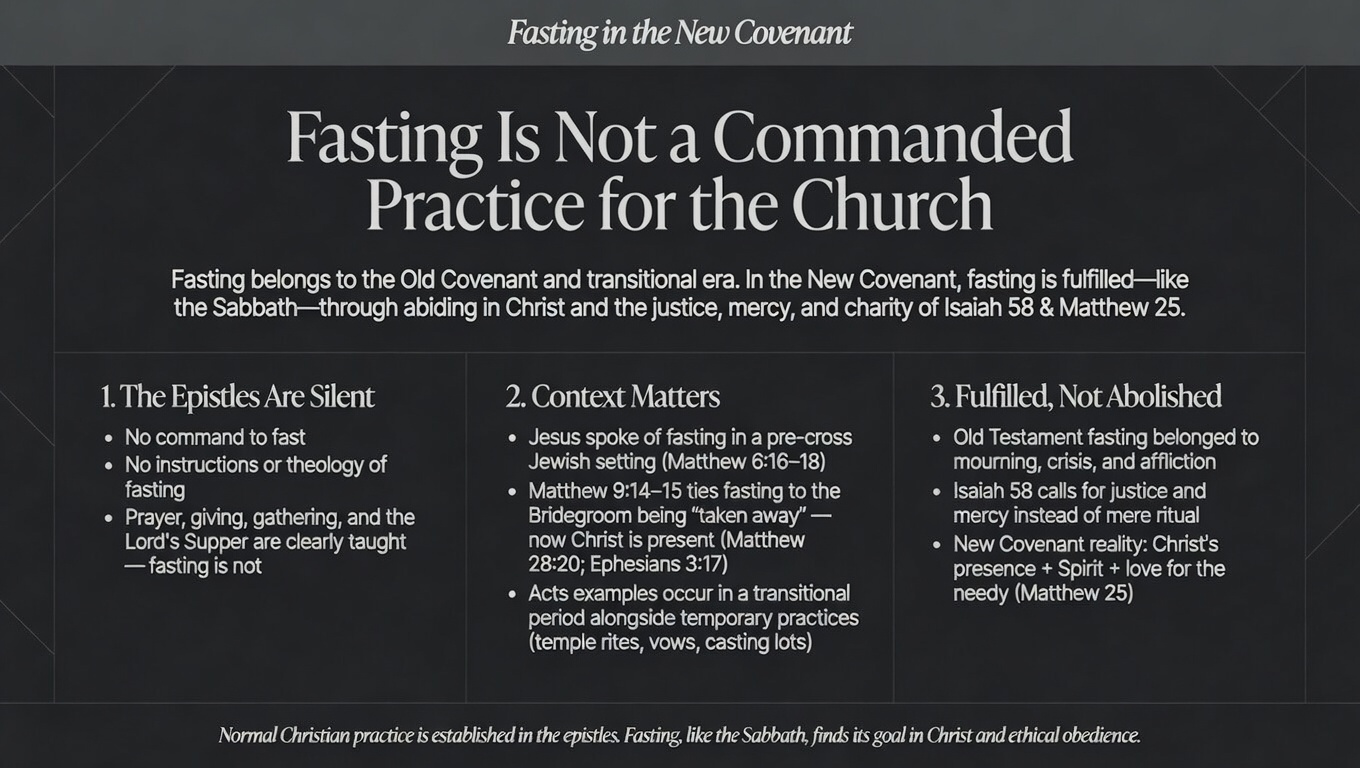
Fasting is not presented in the New Testament epistles as a commanded or normative practice for the Church, but belongs mainly to the Old Covenant framework and the transitional setting reflected in the Gospels and Acts. In the New Covenant, fasting is best understood as fulfilled, in a way similar to the Sabbath, not by the continuation of ritual abstinence itself, but by the believer’s abiding communion with Christ and by the justice, mercy, and charity described in Isaiah 58 and echoed in Matthew 25.
I. Establishing Christian Practice
A basic interpretive principle is that the New Testament itself contains different covenantal settings.
- The Gospels present Christ ministering under the Law and within Israel’s covenantal world (Matthew 5:17–23; Luke 16:16; Galatians 4:4).
- Acts records a transitional period from Old Covenant forms into clearer New Covenant expression (Acts 1:26; Acts 15:1–29; Acts 18:18; Acts 21:20–26).
- The epistles give direct doctrinal instruction to the Church after the death, resurrection, ascension, and sending of the Spirit (Romans 6:14; Romans 7:4–6; Ephesians 2:11–22; Hebrews 8:6–13).
Because of this, normal Christian practice is most clearly established in the epistles, where the apostles address the post-resurrection Church directly.
II. The Silence of the Epistles on Fasting
The epistles clearly teach and reinforce several practices central to Christian life.
- Prayer is plainly commanded and emphasized (Romans 12:12; Ephesians 6:18; Philippians 4:6; Colossians 4:2; 1 Thessalonians 5:17).
- Giving is taught and regulated (1 Corinthians 16:1–2; 2 Corinthians 8:1–9; 2 Corinthians 9:6–8).
- Corporate gathering is emphasized (Hebrews 10:24–25).
- The Lord’s Supper is explained and regulated (1 Corinthians 10:16–17; 1 Corinthians 11:23–34).
- Singing and mutual edification are instructed (Ephesians 5:18–20; Colossians 3:16).
By contrast, fasting is not treated this way.
- No epistle commands fasting.
- No epistle explains how Christians are to fast.
- No epistle develops a theology of fasting as part of ordinary New Covenant life.
That silence is especially striking when compared with the explicit treatment of prayer, giving, gathering, and the Supper.
III. Jesus’ Teaching on Fasting Must Be Read in Context
Jesus does speak about fasting, but the context matters.
In Matthew 6:16–18, Jesus says, “when ye fast,” just as He also refers to almsgiving and prayer in the same section (Matthew 6:1–15). The setting is Jewish and covenantally pre-cross.
This same Gospel setting includes commands and examples tied to Israel’s covenantal life and temple world.
- Leave your gift at the altar (Matthew 5:23–24).
- The scribes and Pharisees sit in Moses’ seat (Matthew 23:1–3).
- Offer the gift Moses commanded (Matthew 8:4).
So when Jesus says, “when ye fast,” the most natural reading is that He is correcting hypocrisy in an already-existing Jewish practice, not necessarily instituting a normative Church ordinance.
His focus in Matthew 6 is chiefly on sincerity before the Father, not on establishing a new Church discipline.
IV. Fasting Is Tied to the Bridegroom Being Taken Away
The key saying is Matthew 9:14–15, paralleled in Mark 2:18–20 and Luke 5:33–35.
Jesus says:
“The days will come, when the bridegroom shall be taken away from them, and then shall they fast.”
This ties fasting to a particular condition: the taking away of the bridegroom.
The most natural reading is that this refers to His death and removal.
But after the resurrection, Jesus emphasizes His abiding presence.
- “Lo, I am with you alway, even unto the end of the world” (Matthew 28:20).
- “Where two or three are gathered together in my name, there am I in the midst of them” (Matthew 18:20).
- Christ dwells in believers by faith (Ephesians 3:17).
- The Church is His body and fullness (Ephesians 1:22–23).
- Believers are joined to the Lord as one spirit (1 Corinthians 6:17).
If fasting in Matthew 9 is linked to the absence of Christ, and Christ is now present with His people in the New Covenant, then the original condition for fasting no longer stands in the same way.
V. Acts Reflects a Transitional Period
Acts contains a number of practices that appear in the transition from Old Covenant to New Covenant clarity, yet are not treated as binding Church norms afterward.
Examples include:
- Casting lots to determine leadership (Acts 1:23–26).
- Ongoing temple-centered devotion among Jewish believers (Acts 2:46; Acts 3:1).
- Circumcision tensions and disputes (Acts 15:1–29).
- Timothy being circumcised for practical reasons (Acts 16:1–3).
- Paul undertaking a vow (Acts 18:18).
- Paul participating in purification rites connected with the temple (Acts 21:20–26).
These passages show that Acts records history during a period of overlap, accommodation, and transition.
For that reason, references to fasting in Acts should not automatically be treated as permanent norms, any more than casting lots, temple vows, or purification rites are treated as permanent norms.
VI. References to Fasting in Acts Can Be Read Within That Transitional Setting
Acts does mention fasting.
- Acts 13:2–3 speaks of ministering to the Lord and fasting.
- Acts 14:23 refers to prayer with fasting in the appointment of elders.
But these references occur precisely in the transitional period already described. The mere presence of an action in Acts does not by itself establish a universal or permanent command. The same book also records practices not continued as binding norms, such as casting lots (Acts 1:26), vows (Acts 18:18), and temple purification rites (Acts 21:26).
So the presence of fasting in Acts is not enough to prove that it is a normative New Covenant ordinance.
VII. Paul’s References to “Fastings” Are Not Decisive
Paul uses the language of “fastings” in 2 Corinthians 6:5 and 11:27.
But the context is important.
In these passages, Paul is defending his ministry through a catalog of sufferings and hardships:
- stripes
- imprisonments
- tumults
- labours
- watchings
- hunger
- thirst
- cold
- nakedness
See 2 Corinthians 6:4–5 and 11:23–27.
Because “fastings” appears in this context of deprivation, many modern translations render the term in ways that stress lack of food or going without food. This makes it possible, and in context plausible, to read these references as hardship rather than as a prescribed religious discipline.
This is especially true in 2 Corinthians 11:27, where Paul’s concern is to recount what he suffered, not to teach a discipline to the churches.
VIII. Some Key “Fasting” Texts Are Textually Uncertain
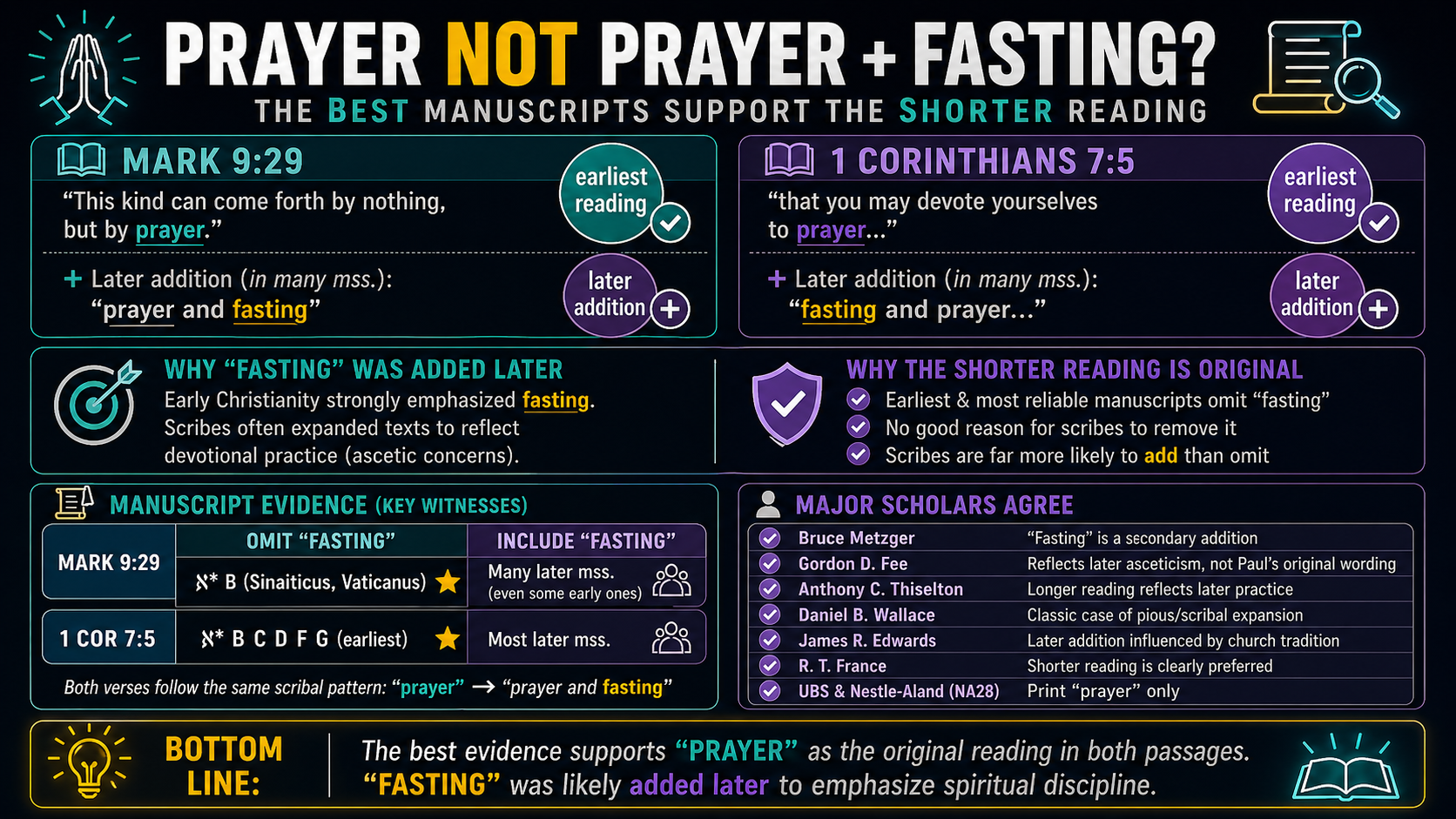
Several passages often cited in favor of New Testament fasting are textually disputed.
- 1 Corinthians 7:5: some manuscripts read “prayer and fasting,” while others read only “prayer.”
- Mark 9:29: some manuscripts read “prayer and fasting,” while others read only “prayer.”
This means that two of the most commonly cited “fasting” texts are not secure enough to bear much doctrinal weight by themselves.
That does not remove the word from every textual tradition, but it does weaken the claim that fasting is clearly and repeatedly established in apostolic instruction.
IX. The Old Testament Framework of Fasting
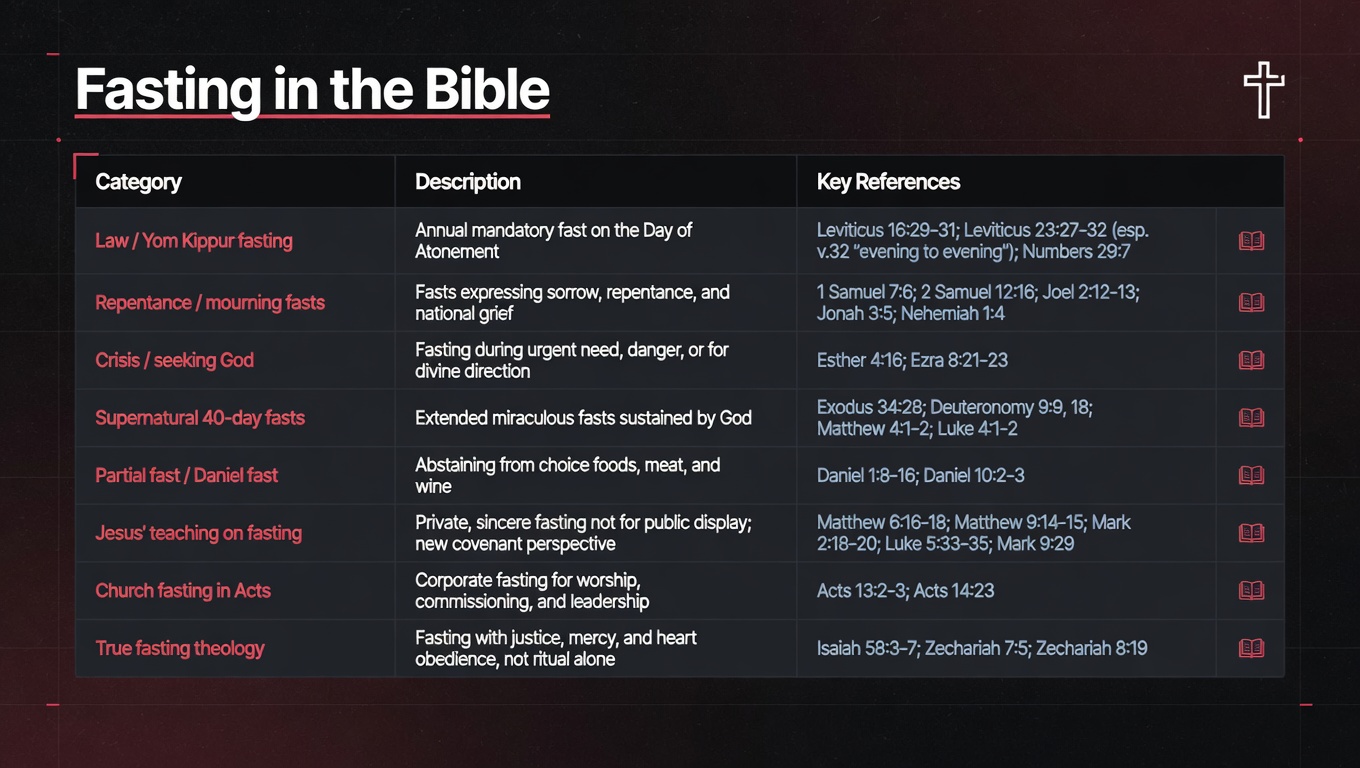
In the Old Testament, fasting is repeatedly tied to mourning, repentance, covenant crisis, and the seeking of divine help.
Examples include:
- The Day of Atonement and afflicting the soul (Leviticus 16:29–31; Leviticus 23:27–32; Numbers 29:7).
- National repentance and mourning (Judges 20:26; 1 Samuel 7:6; 2 Samuel 12:16; Joel 1:14; Joel 2:12–15; Jonah 3:5–10).
- Seeking divine intervention in danger or distress (Ezra 8:21–23; Esther 4:3, 16; Nehemiah 1:4).
- Mourning over sin, judgment, or devastation (1 Samuel 31:13; 2 Samuel 1:12; Nehemiah 9:1; Daniel 9:3).
This shows that fasting belongs naturally to an older covenantal setting marked by crisis, affliction, mourning, and the plea for God’s intervention.
X. The New Covenant Changes That Setting
In the New Covenant, the conditions that generated those fasting patterns are transformed.
- Christ has made full access to God possible (Romans 5:1–2; Ephesians 2:18; Hebrews 4:14–16; Hebrews 10:19–22).
- Christ is with His people (Matthew 28:20).
- The Spirit indwells believers (Romans 8:9–11; 1 Corinthians 3:16; 1 Corinthians 6:19).
- Believers are no longer under the Law in the same covenantal sense (Romans 6:14; Romans 7:4–6; Galatians 3:23–25; Galatians 4:1–7).
- The shadows have found their fulfillment in Christ (Colossians 2:16–17; Hebrews 8:5; Hebrews 10:1).
If Old Testament fasting belonged to an era of covenant affliction, distance, and expectation, then the New Covenant reality changes the theological environment in which fasting functioned.
XI. The Pattern of Continuity and Discontinuity in the New Testament
A broader pattern appears in the New Testament canon.
Practices that continue as central are clearly taught and reinforced after the resurrection in the apostolic letters.
Practices that belong especially to the older order are either explicitly relativized or simply recede as the New Covenant comes into full view.
For example:
- Circumcision is explicitly denied as a requirement (Acts 15:24, 28–29; Galatians 5:2–6; Galatians 6:15).
- Food laws and holy days are relativized in light of fulfillment (Romans 14:5–6, 14, 17; Colossians 2:16–17).
- The priestly and sacrificial order is fulfilled in Christ (Hebrews 7:11–28; Hebrews 9:11–15; Hebrews 10:1–18).
Fasting fits more naturally into this second pattern:
- not commanded in the epistles
- not explained in the epistles
- not reinforced as a central Church practice
XII. Fasting May Persist Only as Optional or Residual
Even if one grants that fasting still appears occasionally in the New Testament record, the strongest conclusion that follows is that it may remain optional, not normative.
That is, fasting could be viewed as:
- a carryover from earlier covenant life
- a voluntary act rather than a commanded one
- something permitted without being prescribed
This is a much more limited claim than saying fasting is a defining or required New Covenant discipline.
XIII. Isaiah 58 Points Beyond Ritual Abstinence
Isaiah 58 is one of the most important Old Testament texts on fasting because it critiques merely external fasting and points toward something deeper.
The chapter shifts attention from ritual abstinence to ethical obedience:
- loose the bands of wickedness (Isaiah 58:6)
- undo heavy burdens (Isaiah 58:6)
- let the oppressed go free (Isaiah 58:6)
- deal bread to the hungry (Isaiah 58:7)
- bring the poor into your house (Isaiah 58:7)
- cover the naked (Isaiah 58:7)
This anticipates a form of obedience fulfilled not in asceticism as such, but in justice, mercy, and love.
That same emphasis appears in the teaching of Christ.
- “I will have mercy, and not sacrifice” (Matthew 9:13; Matthew 12:7, citing Hosea 6:6).
- Christ identifies Himself with “the least of these” in works of mercy (Matthew 25:31–46).
- Pure religion is expressed in care for the afflicted (James 1:27).
- Love fulfills the law (Romans 13:8–10; Galatians 5:14).
So what ritual fasting pointed toward finds its fulfillment in the New Covenant life of mercy, justice, and practical love.
XIV. Fulfillment Like the Sabbath
This is why fasting may be understood in a way similar to the Sabbath.
The Sabbath is not simply erased; rather, it is fulfilled and brought to its goal in Christ.
- Christ is Lord of the Sabbath (Matthew 12:8).
- Sabbaths were a shadow of things to come, but the body is Christ (Colossians 2:16–17).
- The true rest of God is entered through faith and fulfilled in Christ (Hebrews 4:1–11).
- The Prophet Isaiah in chapter 58 reframes true fasting as acts of justice, mercy, and liberation—loosening the bonds of wickedness, caring for the poor, and walking in righteousness—showing that the substance of fasting is fulfilled in a transformed life.
- The Prophet Zechariah in 8:19 promises that the fasts of Israel will be turned into “joy and gladness and cheerful feasts,” pointing to their fulfillment in the restoration and joy found in Christ.
In a similar way, fasting need not be treated as though it were merely abolished in a negative sense. Rather, it may be understood as fulfilled: its symbolic, covenantal, and afflictive features give way to the greater reality of abiding in Christ and living out the justice and mercy to which it pointed.
Conclusion
Taken together, the argument is as follows.
- Fasting is not commanded in the New Testament epistles.
- Jesus’ statements about fasting arise in an Old Covenant setting.
- Matthew 9 ties fasting to the taking away of the bridegroom, whereas the risen Christ is now present with His people.
- References to fasting in Acts occur in a transitional period that also contains other practices not treated as normative.
- Paul’s references to “fastings” occur in contexts of hardship and deprivation, not in doctrinal teaching about Christian practice.
- Several major “fasting” texts are textually uncertain.
- Old Testament fasting belongs to a covenantal framework of mourning, affliction, repentance, and crisis.
- Isaiah 58 points beyond ritual fasting to justice, mercy, and care for the needy.
- In the New Covenant, that ethical reality is brought forward in Christ and in the life of the Church.
For these reasons, fasting is best understood not as a commanded norm of New Covenant life, but as an Old Covenant or transitional practice whose deeper purpose is fulfilled in Christ, much as the Sabbath is fulfilled in Him.